Homecourt Comedy
A live comedy competition, turned into a scoring system real audiences used for over a year.

How I got in
This one didn't come through a pitch. I'm a regular at a jazz bar where a friend books the comics, so I already knew the room and the people running it. By the third night of the show, I wasn't a consultant they'd hired. I was running the door. That vantage point, inside the room, watching how the competition actually felt, is what the whole system got built from.
The problem
A rowdy room isn't a fair competition.
Two versions
Prove the model first. Then make it feel live.
I didn't start with an app. I started with the data model. If the scoring logic didn't hold up, no interface would save it.
An Airtable system
Shows, sign-ups, scorecards (1–10), gold stars, a "reason for 0" field, and normalized comedian identities. The whole competition ran on it, proving the model against real nights before a line of app code.
An iOS scoring app
QR check-in, a judge profile, score the comic on stage, one gold star to spend, a leaderboard. Scoring dropped from 1–10 to 1–5, a live audience needs a snap judgment, not a deliberation.
The system
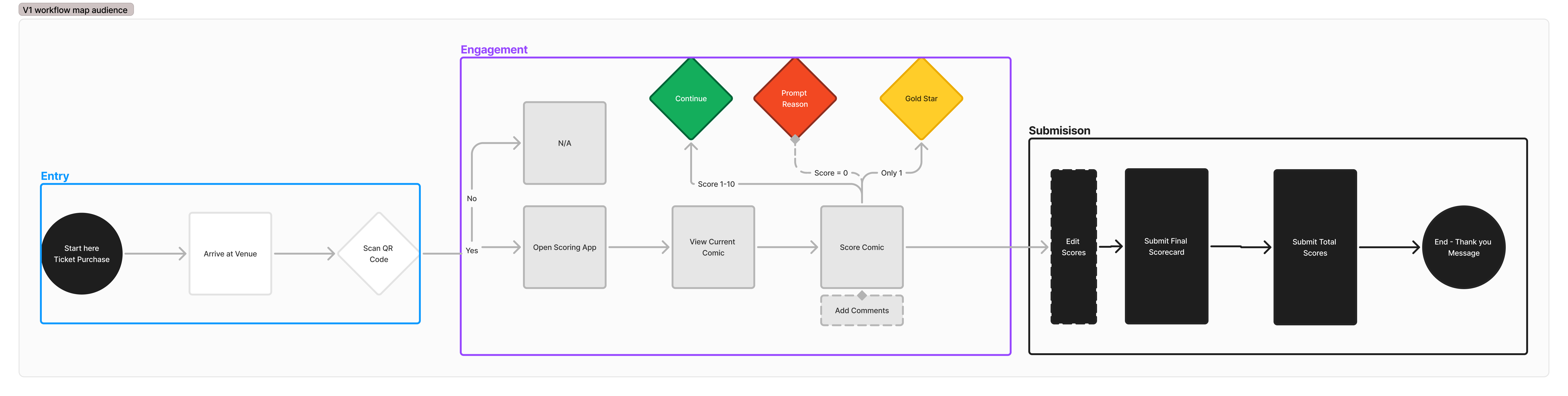
Entry, engagement, submission.
The audience flow runs end to end: buy a ticket, arrive, scan a QR to check in, open the app, score the current comic 1 to 5, submit. The interesting decisions live in the middle, the two scoring rules that keep the data honest.
A zero requires a written reason. No drive-by hate.
One gold star per judge. Scarcity makes the signal mean something.
The thinking on paper
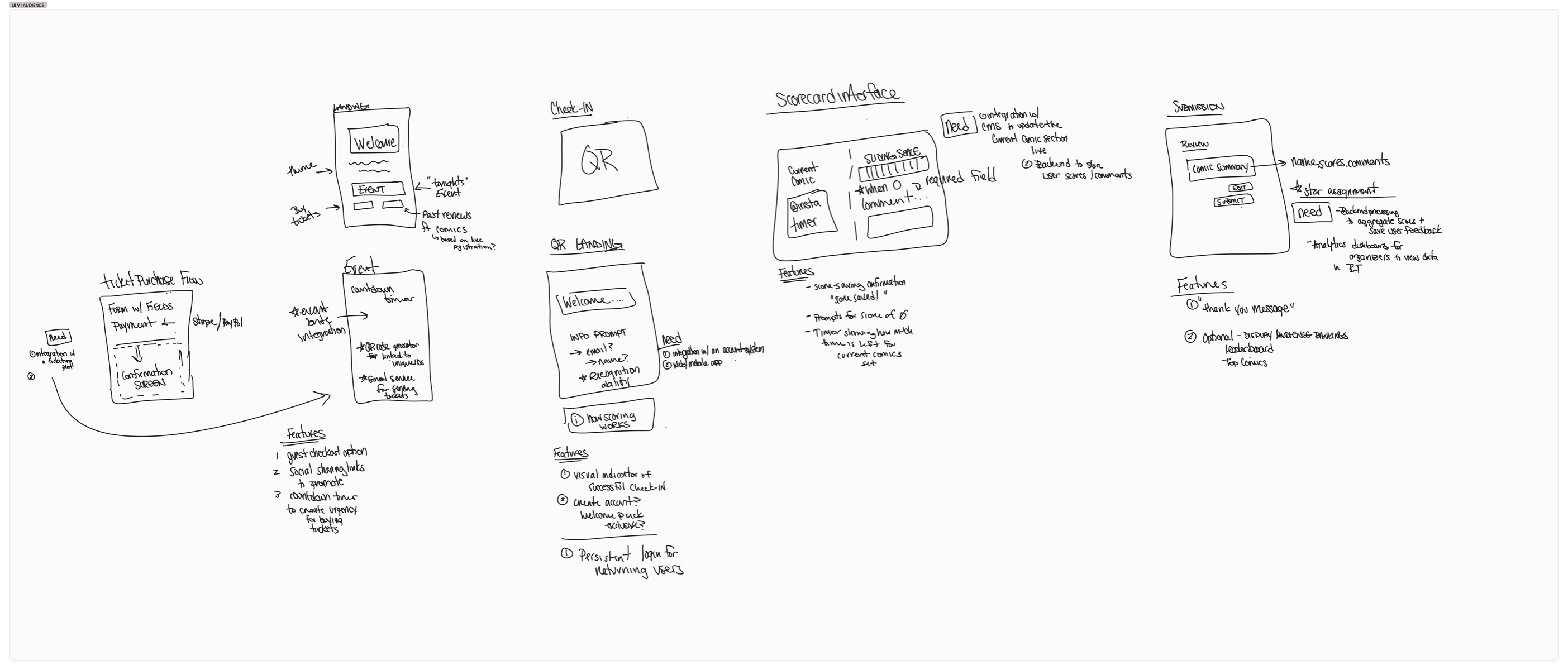
The flows were designed by hand first, ticket purchase, check-in, the scorecard interface, submission, each with the features and the back-end needs noted right on the page. This is where the system actually got decided.
The app
Simple enough for a live room.
One job: get an audience member from "I don't know how this works" to "I just scored a comic" in seconds. A launchpad, a lightweight judge profile, the current comic, a score, a gold star. Nothing to read, nothing to learn.
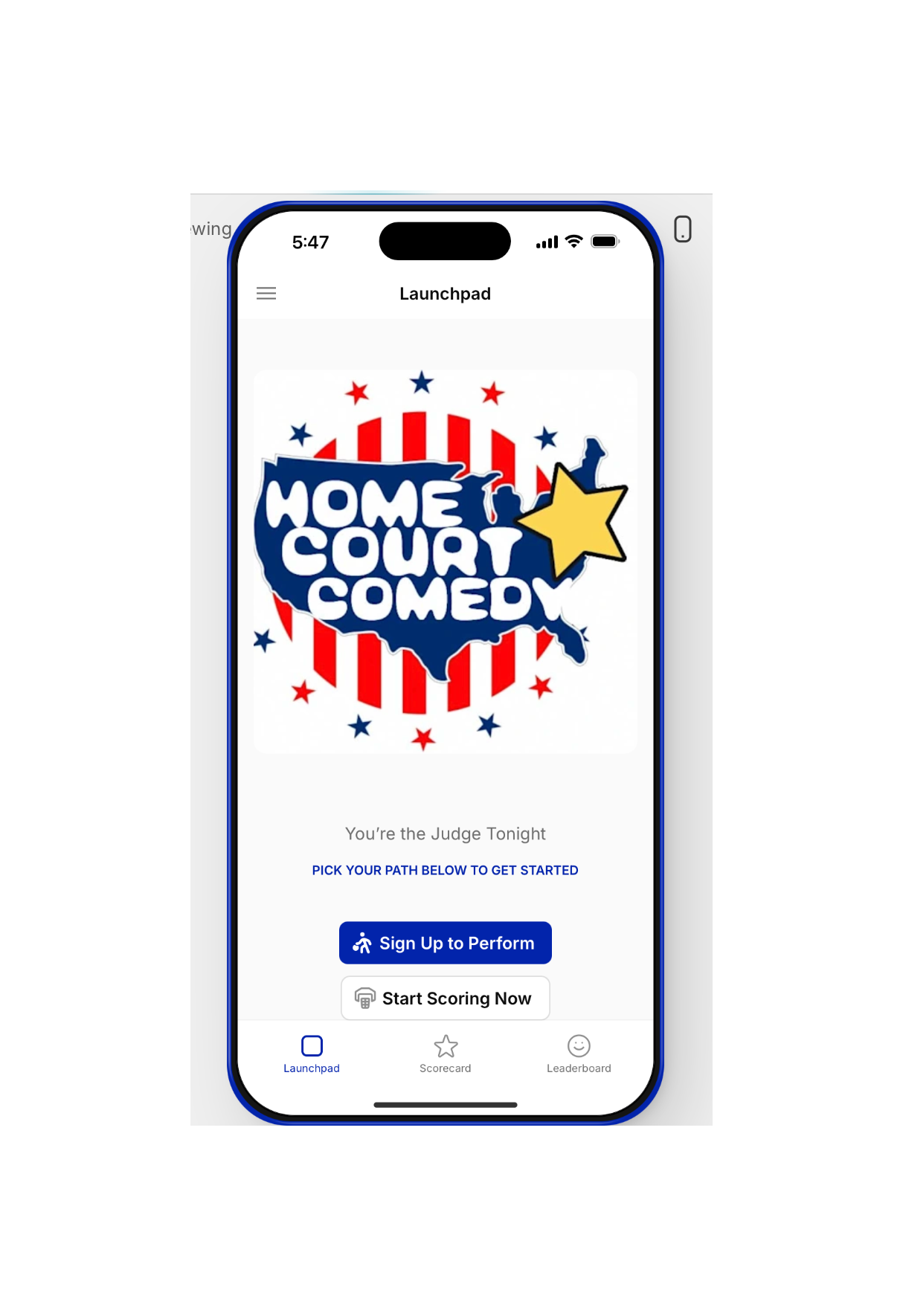
The launchpad. Two doors, sign up to perform, or start scoring, under the show's own identity, so the app feels like the night, not a form. More screens once names and emails are redacted for public use.
What actually happened
People used it. For a year and a half.
Not a concept. The system ran a live, recurring show and collected real data the whole time.
Across those nights, ~110 unique comedians moved through the system, messy sign-up entries resolved to canonical identities so a comic's history held together week to week.
The proof outside the data
The concept proved itself in the room.
What it proves
Homecourt is the clearest version of the thing I do: take a live, subjective, disappearing human moment, a set, a laugh, a room's verdict, and give it structure, rules, and a record, so it becomes fair, comparable, and owned. Same instinct as everything else I build; here it ran in the wild, with real people, for over a year.
Real, shipped, and used: a live weekly show ran on this system across 47 events. V1 was an Airtable configuration; V2 was an iOS prototype (built on Glide) with live scoring, a working prototype, not a public App Store product.
Consulting engagement. All audience and comedian data shown here is aggregate; individual names, handles, and scores are private to the show.